The alley looks considerably less mysterious in daylight.
By night, it had been a narrow, neon-soaked throat of brick and shadow, humming with refrigeration units and the vague promise of supernatural consequence. By morning, it is a mundane service corridor with significantly more visible garbage. The dumpster smells worse in the heat, which I hadn’t thought was physically possible.
I crouch near the spot where I found the box, scanning the pavement with the focused optimism of someone who has absolutely no idea what they’re looking for. A clue would be nice. A glowing symbol, maybe. A business card from a wizard. Something that screams yes, this is where the supernatural item lived before it ruined your life. The pavement offers cracked asphalt and a flattened straw wrapper. I give both a fair chance. Neither delivers.
Tim circles the dumpster with the focused intensity of someone who has watched exactly enough true crime documentaries to feel competent, but not quite enough to be useful. Her ponytail swings with each turn of her head, catching the morning light with the kind of casual elegance that probably takes other women forty minutes and a YouTube tutorial.
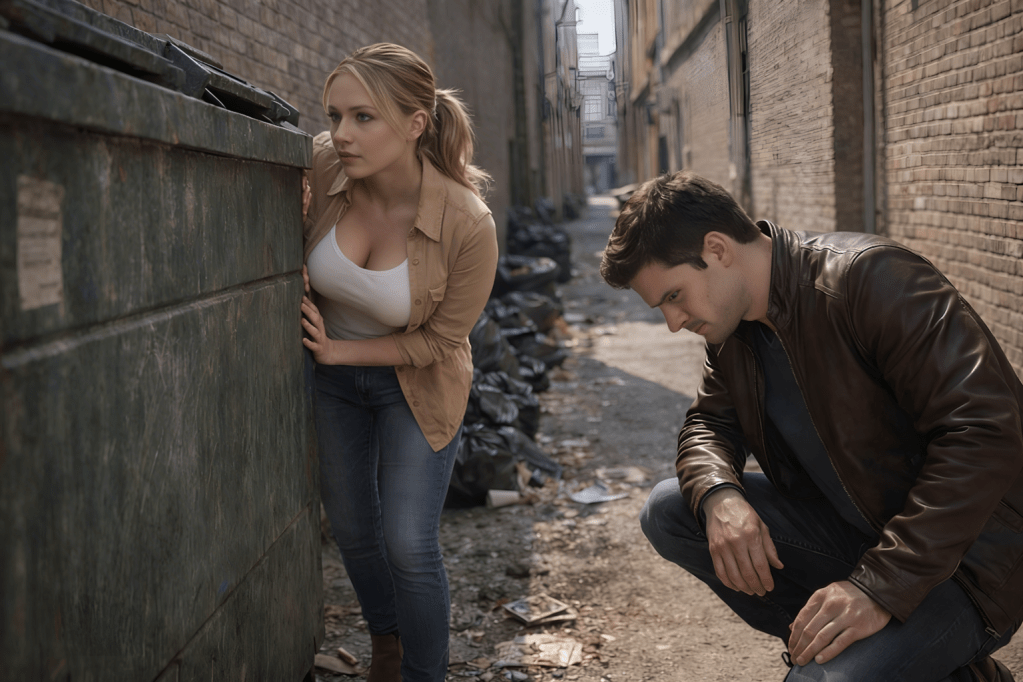
“There’s nothing here,” she announces, directing a small pout at a soggy cardboard box that had clearly offended her by existing.
“Well,” I say, standing and pressing a hand to my lower back like a man twice my age, “it was a long shot.” I survey the alley with the resigned acceptance of someone who had expected disappointment and was still somehow disappointed. “Maybe someone inside saw something? A staff member, a cook. Worth asking.”
Tim turns the idea over. She doesn’t look convinced, but then she looks up, and something shifts in her expression. The pout evaporates.
“Oh, a camera.” She points up. “Does that cover where you found the box?”
I follow her finger. Sure enough, a camera is bolted above the kitchen exit, aimed directly down the alley peers down from above.
“I think it might,” I say.
She’s already heading for the door.
The restaurant manager is a compact man in his early forties with the specific bearing of someone who considers himself extremely reasonable until someone asks him to be. His office smells like printer paper and faint desperation. A motivational poster on the wall instructs me to Work Hard, Dream Big, and I make a private note to never take life advice from a restaurant manager’s office décor.
I had intended to do the talking. That was my plan. A perfectly reasonable, straightforward plan.
Tim has other ideas.
She leans forward across the desk, elbows resting just so, head tilted at a precise angle, and produces an expression I can only describe as weaponized sincerity. The ponytail falls over one shoulder. The V-neck of her shirt does what V-necks do.
She seems completely unaware of any of this, which is more than a little worrying.
“We just want to know what the person looked like,” she says continuing her request, her voice soft and earnest. “We found something, and we’d really love to return it directly to the right person. It’s important.”
The manager blinks. His professional bearing hasn’t collapsed yet, but it has developed a visible crack. “You could leave it here. We hold lost items at the front desk. Or you could leave your number. In case someone asks.”
“How bold,” Tim says with a flirty smile. “Already asking for my number.”
“No, that’s not-“
“I’m kidding.” She laughs, bright and easy, and the manager smiles completely caught up in her pace. “Look,” she continues, “we’re not trying to make trouble. We just want to see if the camera caught a person.”
She finishes with a small, earnest smile. I watch, with something approaching scientific detachment, as the manager’s professional resolve quietly packs its bags and slips out the back.
“I’m not supposed to share the footage directly,” he says, in the tone of a man explaining a rule he is already planning to break. “But I can have someone go through it. Flag anything that looks out of place.”
Tim’s face transforms. Full smile, completely unrestrained. “Thank you so much.” She plucks a pen from the desk with the casual familiarity of someone who owns the room, scribbles on a Post-it, and slides it across. “That’s the best way to reach me.” A small pause. A teasing smile. “I suppose you got my number after all.”
The manager stares at the Post-it with the expression of a man who has been handed something he doesn’t fully understand but intends to treasure.
I hold the door open for Tim on the way out. She breezes through it without looking back, ponytail swinging.
“I did it,” she announces, with the pleased, satisfied air of someone who has discovered a new skill and is already thinking about where else it might apply.
“You had him the moment you walked in,” I say. Then, teasingly, I add, “Are you sure you want to change back? You’re quite good at being a girl.”
A complicated expression crosses her face, the kind where several feelings show up at once and none of them are sure who called the meeting. She opens her mouth, closes it, and says, with slightly less conviction than I think she intended:
“Well. Of course I do. I just have to use what I have, right?”
I let that sit exactly where she put it and don’t touch it.
“Anyway,” Tim says, pivoting sharply toward the dining area. “Let’s eat. Their chicken pasta is incredible. We skipped breakfast, and I am not capable of making good decisions on an empty stomach.”
My stomach rumbles at the mention of food; my stomach can’t overcome the emptiness of my wallet.
“You think I can afford this place?” I smirk. “The appetizers will bankrupt me.”
Tim loops her arm through mine with the natural, unthinking ease of someone who has always done it. Her shoulder presses against my arm. She smells like something expensive and faintly floral. She’s only been a girl for a day; how does she already have floral shampoo?
My higher reasoning functions take a brief, unscheduled break.
“Don’t be ridiculous,” she says, tugging me toward the host stand. “I’m paying. You’ve been trying your hardest to fix things. The least I can do is buy you lunch.”
I put up a token protest. It lasts approximately four seconds. I cannot turn down a free meal. That’s not weakness; that’s principle.
The restaurant is aggressively tasteful. Soft lighting, neutral tones, table settings that imply a culinary philosophy. The kind of place that serves water without asking and makes you feel vaguely underdressed for drinking it.
We’re given a table. Everything feels so mundane and moves at its usual pace, indifferent to the fact that the woman sitting across from me was, as of roughly twelve hours ago, a moderately drunk man in a business casual shirt, complaining about his ex-girlfriend.
Without the box, without the active crisis, the conversation finds its own level. We talk about nothing with the particular ease of people who have collectively survived something bizarre and earned the right to ignore it temporarily. She tells me about a vacation two years ago where everything went wrong in escalating and increasingly comedic ways. I tell her about the time I drove a bachelorette party to four separate venues and emerged a changed man. She laughs at all the right parts, and some of the wrong ones, which is its own appeal.
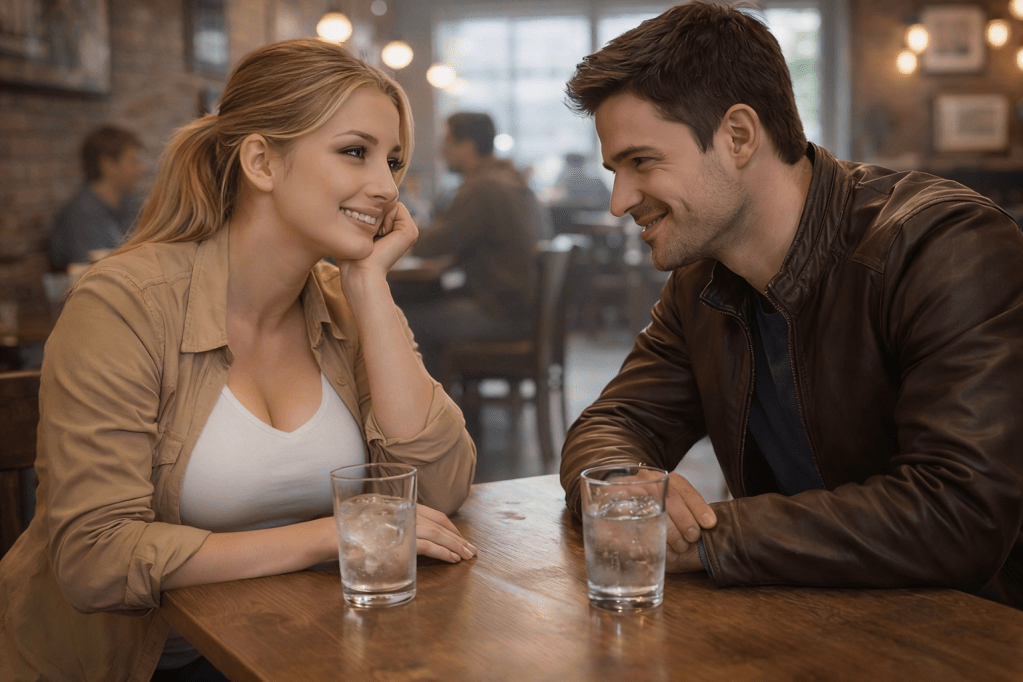
Somewhere between the second story and the third, I catch myself forgetting.
Not forgetting forgetting. I know. The information is there. But it stops being the first thing and starts being the third or fourth thing, and then somewhere it becomes a fact I’m aware of the way I’m aware of the ambient music: present, noted, not particularly central.
She catches me looking and raises an eyebrow. I smile awkwardly as I take a sip of water.
Our waiter arrives with the practiced weariness of a man who started this job with ambitions and has since revised them several times. Mid-thirties, maybe, though the particular exhaustion and build he carries adds a decade at a glance. He approaches with his notepad and the grim professionalism of someone who has heard every variation of every order and remained standing.
He glances at Tim when he arrives. The glance lasts slightly longer than a glance technically needs to. I can’t blame him. Then he resets, as a professional.
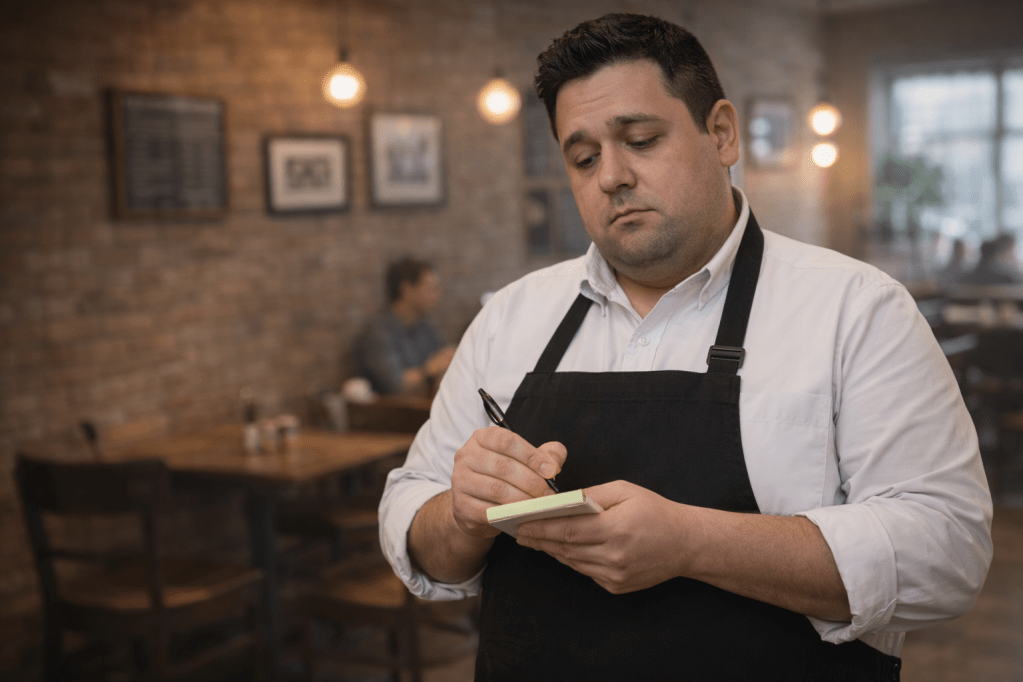
“Welcome. Can I start you off with anything, or are you ready to order?”
“The Saffron Chicken Confit Pasta,” Tim says. She hasn’t touched the menu. “Smoked paprika cream on the side, light on the cream, and make sure the chicken hasn’t been sitting.” She delivers this the way someone gives their coffee order to a barista who already knows it: pleasantly, efficiently, from memory.
I scramble for the menu with the energy of someone who has never been in this kind of restaurant and is extremely aware of it. Words swim past me. Confit. Reduction. Deconstructed. Things described as composed. One item appears to be mostly a concept.
“Burger,” I say, with enormous relief, upon locating it. “And fries.”
Tim turns to look at me with an expression of deep, personal disappointment.
“Quinn.”
“Absolutely not.”
“There’s a duck confit on the—”
“I’m getting the burger.”
“It’s so boring,” she says, in the specific tone of someone who finds a person’s predictability both exasperating and a little endearing. She props her chin in her hand. “You’re at a restaurant, not a drive-through.”
“And I know burgers, it’s safe. I know I’ll like it,” I say with a bit more of a whine than I intended.
The waiter, to his considerable credit, writes it down without comment and retreats with the quiet, dignified efficiency of a man who has heard this exact argument many times and taken no side.
Tim watches him go, then turns back to me, still looking faintly wounded on behalf of the duck confit.
“You’re impossible,” she says. The smile tugging at her lips suggests she doesn’t entirely mean it.
We fall back into conversation easily — more stories, more comfortable teasing, the rhythm of two people who are getting used to each other faster than either of them has accounted for. Restaurants like this run on long wait times. We have plenty.
Halfway through Tim’s retelling of a particularly disastrous ski trip, my thigh gets warm.
I shift in my seat and ignore it. She’s at the part where the rental shop gave her the wrong boots, and I am a supportive conversationalist.
Warmer.
I reach into my pocket for my phone as an automatic reflex and find it immediately in my left pocket, exactly where it lives. Screen dark. No notifications. Perfectly normal temperature.
The warmth is in my right pocket. My heart beats faster.
My right pocket, where I specifically, deliberately, with great intention, did not put the box this morning.
I reach in. Warm metal meets my fingers. I remove my hand as casually as I can manage, as though nothing has happened, and nod along while Tim describes an instructor who was condescending about boot sizing.
It’s here. It followed me.
“Quinn?” Tim tilts her head, cutting off her story. “You okay? You look pale.”
I weigh the options, decide honesty is both unavoidable and necessary. I whisper like the box could overhear me if I spoke too loudly, “The box is in my pocket. It’s getting warm.”
Tim blinks. “You brought it?”
“I didn’t bring it. I left it on the coffee table. I checked. I double-checked.” A beat. “I think it followed me. It feels-” I search for the word. “Smug. Vindictive.”
Tim unconsciously scoots away from me. “Is this about the clothes?”
I nod. “I think so. Or leaving it behind.”
A short, grim silence. Tim gives me a I told you so look.
“I should go,” I say. “Before it activates. I don’t want to change you or anyone else in the middle of a restaurant.”
Tim looks like she wants to argue. She doesn’t. “Come back to my place when it settles. Maybe you can exhaust it on clothes again.”
“Good idea.”
I rise slowly, the way you move around something that might startle. My caution counts for nothing. Halfway out of my seat, the box spikes. Not with the building, rhythmic pulse I’d felt before, but instantly, totally, a white-hot flare from my pocket so sudden I flinch. The silver box blazes against my thigh with the triumphant, slightly unhinged energy of something that has been waiting patiently for exactly this moment and is done being patient.
But in that low, resonant place behind my sternum where the connection to the box lives, I feel something that has absolutely no business existing in a metal rectangle: glee. Pure, vindictive, slightly manic glee. The specific joy of a plan arriving on schedule. I feel energy flow away and toward the box as it finishes its activation.
Then, like a switch thrown, it goes ice cold. Dead. Still. Silent.
I exhale and look at Tim apologetically.
Tim has both hands flat on the table. She’s looking down at herself, braced, waiting.
Nothing happens.
Her jacket sits where it was. Her ponytail is undisturbed. She presses a cautious hand to her unchanged chest and takes a slow breath. “I’m fine? It didn’t-“
“Your food,” a voice sounds above us.
We both look up.
Our waiter has returned. He’s carrying both plates with the flat competence of someone who has done it ten thousand times, eyes already scanning the table for space, expression professionally neutral.
“Please make room for your-“
He stops.
Not trailing off. Stops. Mid-sentence, mid-step, both hands still holding the plates. His expression doesn’t change so much as it suspends, like someone has pressed pause on whatever was happening behind his eyes.
Then a visible shiver moves through him, starting at the back of his neck.
He straightens — and it is not the straightening of a man deciding to stand taller. It is the straightening of a spine rearranging itself from the inside. The shoulders roll back and inward simultaneously. The whole frame narrows by a degree so subtle you’d miss it if you weren’t watching for exactly that.
I am watching for exactly that.
His face goes first, or maybe it just goes most visibly. The jaw softens; a slow, inexorable thing, losing the blunt, squared-off weight of it, rounding at the corners in a way that looks less like change and more like revelation, as if that shape had always been underneath and was only now letting itself out. The cheekbones rise, prominent without becoming sharp. The forehead smooths. The lines at the corners of his eyes ease, not vanishing, just lifting into something that reads completely differently.
His hair, black and close-cropped, begins to lengthen. Not dramatically. A slow, dark tide, curling past the collar of his white shirt, tucking behind an ear that has grown small and delicate. His lashes thicken. His lips part, and when they close again, they are fuller, with a natural, soft bow at the top that hadn’t been there before.
He blinks. His eyes, already dark, have deepened into something warmer.
He blinks again, like he’s trying to recalibrate.
The apron strings pull taut.
The white button-down doesn’t strain dramatically. It just becomes insufficient in a very quiet, unavoidable way. The chest filling it is no longer the chest it was fitted for. The fabric redistributes with the same quiet insistence I’d watched it take with Tim, drawing in at the waist, pulling at the collar, pressing forward with a polite, relentless certainty. The buttons hold. Barely.
His frame drops two, maybe three inches in a subtle compression, inward and downward. The apron strings, looped and tied around a waist that is no longer that waist, go briefly slack before pulling snug around a silhouette that nips inward with a clean, involuntary taper. The black slacks, which had been unremarkable, redistribute quietly around a figure that has revised itself without asking anyone’s permission.
A soft sound escapes her lips. Not pain. Not quite surprise. The sound of someone surfacing somewhere they didn’t expect to be. Her eyes regain focus as she blinks multiple times to understand what just happened.

She stands beside our table with both hands still raised as she holds our plates of food, breathing in shallow, careful increments. Dark hair resting on her shoulders. The white shirt looks bulky and tight at the same time. An apron that has absolutely no idea what just happened to it.
She looks at the plates she’s still holding. Then at her new body. The sequence of a person trying to locate themselves using familiar objects. Her brain doesn’t quite register what had happened.
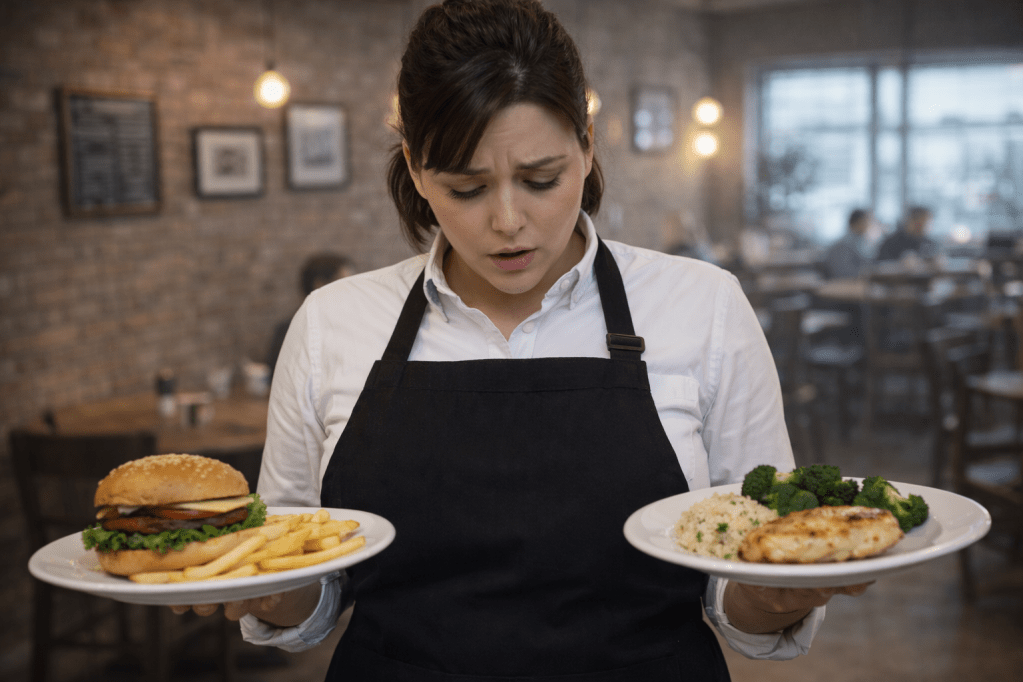
Tim and I look at each other. The entire wordless conversation happens in approximately one second.
She sets the plates down. Not gracefully, with a clatter that makes the nearest table glance over. The other diners, finding nothing obviously wrong, return to their conversations. Nobody seems to have seen the transformation.
We both stand. Tim takes one elbow, I take the other, and we guide her toward the door with the coordinated urgency of people who have done this before, which we have, once, under nearly identical circumstances, which does not make it less surreal.
“It’s okay,” Tim says, low and steady. “We’ve got you.”
“I’m a-” she starts. Her voice has changed, and she knows it. She stops. Tries again. “I’m a girl.”
“Yes,” I say. “We’ll explain everything outside.”
She looks back toward the restaurant, toward the tables, the other servers, the kitchen window with the expression of someone calculating the distance between where they are and where they’re supposed to be.
“I can’t just leave,” she says. “My shift-“
“I’d say you have bigger things to worry about,” I say, as gently as I can.
She lets us steer her through the door.
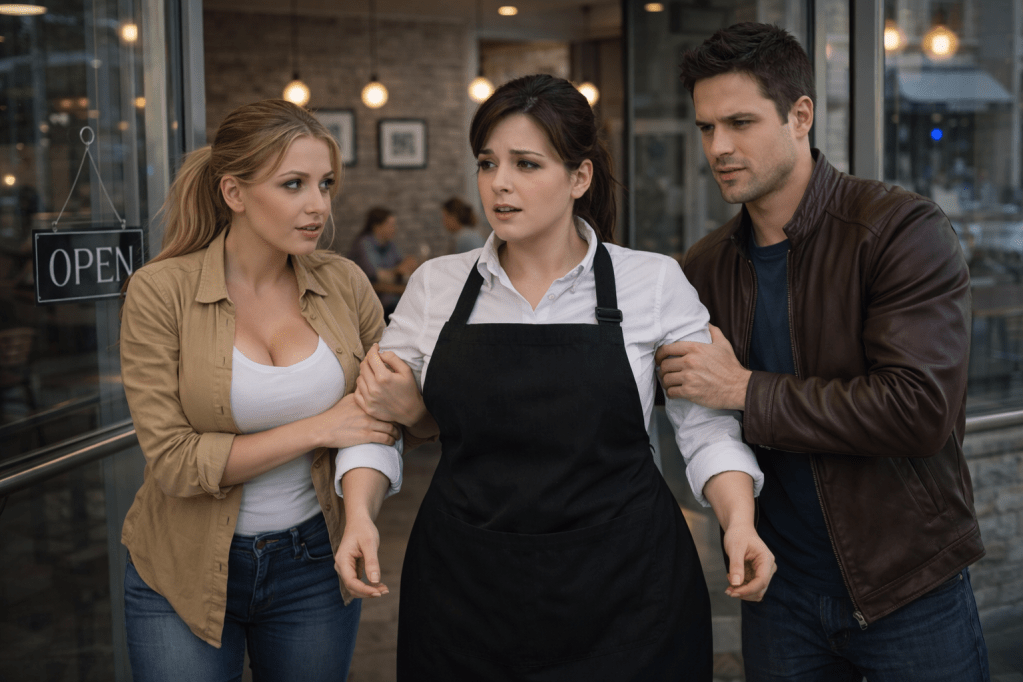
Outside, the city receives us with its usual complete indifference. I feel like someone is about to point at me and condemn me for ruining two people’s lives. That I’m on the verge of being arrested and taken away, never to be seen again.
But nothing happens as we make it to my car and drive away.
As I drive, I can feel the box in my pocket, cold and silent and deeply, profoundly satisfied with itself.
 TheXtra Path
Leave a comment